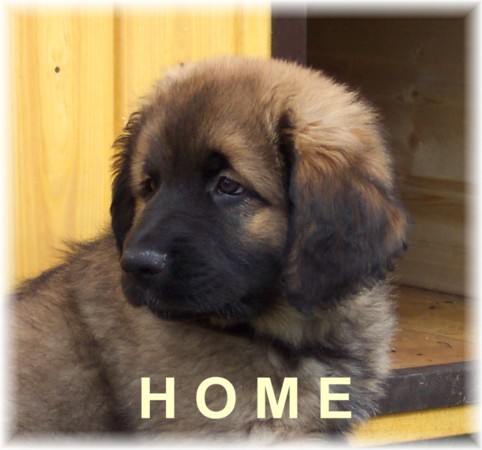
Welcome
to the Homepage of Marzipan Vom Matthiasberg "Mador"!
(HCH
Liam Vom Matthiasberg x HCH Hildegard Vom Matthiasberg) Breeders: Lajos
Mészáros, Monika Nyitrai
Owner: Leidl Andrea H-1108 Budapest, Pázsitfû u. 1. Hungary
Mobile: +36-70-315-4758 E-mail: leidla@hotmail.com

















Dog Training
Dog Training, in different forms, is known to everyone who has a dog. It gives the owner such a pleasure when a dog fulfills the simpler command (i.e. sit) even when it goes on the street perfectly disciplined or goes through an exam test!
I began dog training with Alex in 1995 since if you go to the street without it, it won't be a walk but rather "water skiing on the pavement"... We went to Cerberos Dog Training School since the age of 8 months of Alex, where positive methods (food, playing) were used to train the dogs gradually. Here (too) I would like to thank Magdolna Nemeth, Head of School, for all her work and professionalism.
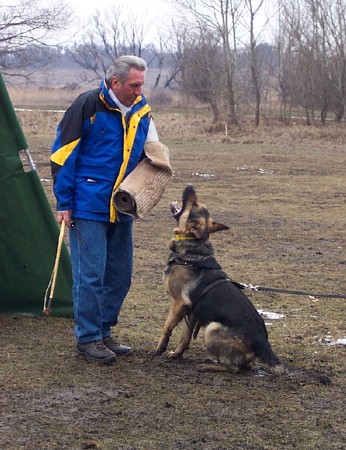
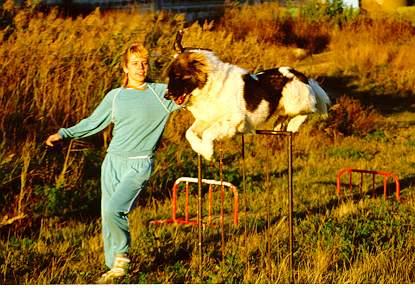 Alex over obstacle (1997) |
|
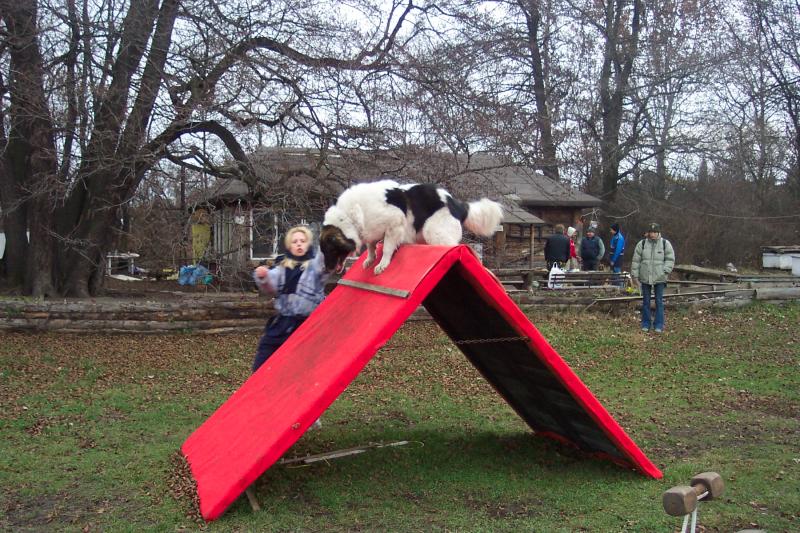
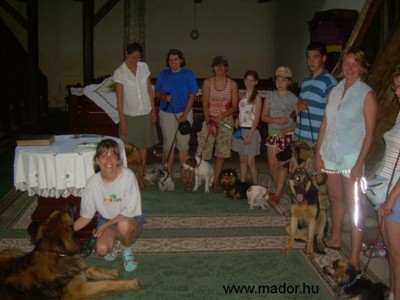
You don't only go to a dog training school to teach trick to your dog: it is also a place to meet people like you, having the same interests, sharing the same joys and problems, and create friendships. There builds a sense of belonging to each other, and, in addition, the dogs have a good time, too.
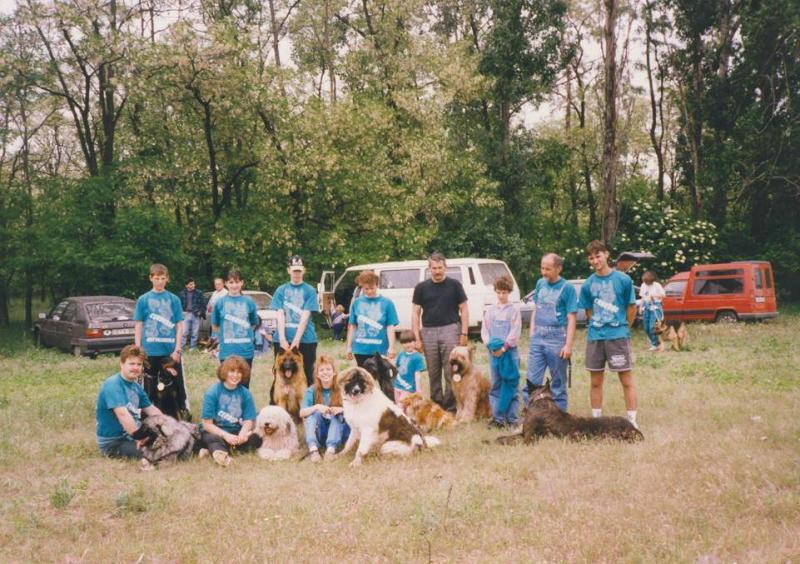
Members
of Cerberos Dog Training School
I think important to state that dog training in its classical meaning consists of the Tracking - Obedience - Defense pillars (Sport training) ideal for the structure of defense dogs like german shepherds, rottweilers, giant schnauzers, etc. With many other kind of dogs the methods and exercises simply do not compile with the type of the dog (i.e. there is no use to teach a vizsla or golden retriever for defense work). There is a difference at the endurance of the dogs so even specimen within the same kind are not the same.
When selecting a puppy it is very important to decide why we need the dog for, taking into consideration our own circumstances (owner's nature, neural type, garden or appartment, time schedules, etc.). We find real joy in our partner if (s)he performs well the tasks important for us, and in addition we have a happy dog.
This is why we need to pay attention to the nature of the dogs and the relationship between owner and dog, so in my opinion there are no methods useable for everyone, and you can't simply learn them from books, but instead we need to combine scientific background, practical methods and owner/dog characteristics at dog training.
German Shepherd Club of Hungary course - 4TAPPANCS courses - MEOE Ring Secretary course
Mirror Method basic trainer courses - OKJ Habilitation Dog Trainer course
German Shepherd Club of Hungary course
In order to know not only the practical side of dog training, but also the theories behind, at the beginning of 2004 I went to the Dog Trainers Course organised by the German Shepherd Club of Hungary, headed by Dr. Zoltan Bartolak and Gyorgy Kovacs. Topics of the course included:
- Etology (science of dog behaviour)
- Conditioning, learning, reflexes, confirmation methods
- Instincts, instinctive behaviour and its role in dog training
- Anatomy, dog show judging
- Inherited behaviour elements
- Dog training methods
- Learning processes of dogs, trainings
- Areas of sport dog training (tracing, obedience, protection)
- Methods of teaching sport dog exercises
- Elements of "Good Citizen" training
- Regulations of Examinations
- Training Theory
- Proposed health programme for German Shepherd dogs
- Dog training in practice
At the end of the course we had an examination of a total of 90 open questions for 350 points (it took 6 hours to write it). Diploma qualification depended on the result of the test: over 90 % (i.e. 315 points) it's "Excellent" (like "A"), the result of the bests were like "A+". In the group we were 2 who had A+ qualification (I wrote 346 points i.e. 99%).
 My Dog Training Diploma |
|

It was an extra motivation that those with A+ qualification could participate
free of charge at Mr. Friedrich "Fritz" Biehler's 2-day seminar.
He is "the living legend", the most successful dog trainer
of all times, multiple German champion, SV-Bundessieger, European Champion,
World Champion. I felt honoured because Mr. Fritz Biehler wrote encouraging
words on my Dog Training Diploma.
|
|
|

4TAPPANCS (4PAWS) alternative dog trainer course aims to educate dog trainers conducting individual and group courses and consultations on dog training, and resolve dog-related problems. They use modern dog training methods from contemporary international dog training specialists like Victoria Stilwell, Jan Fennel, Martin Rütter, Turid Rugaas, Clarissa von Reinhardt, Celina del Amo, Cesar Millan. I would like to express my special thanks to Mr. Stefan Siman for compiling and delivering these courses, and continuously helping me with all my questions.
This is a modular course, using e-learning methods as well. Here are the courses and modules that I have participated at:
|
Calming
Signals
|
|
|
|
|
I
found this course very informative and interesting. I especially
enjoyed the videos of the fantastic contemporary specialists, scientists
and dog trainers. I was amazed by the 28 (!) calming signals identified
by Turid
Rugaas (i.e. turn head, blink, lick nose).
|
|
|
Clicker
Training for Beginners
|
|
|
|
|
Although
I trained Mador with "traditional" methods based on positive
reinforcement, I found clicker training and the related videos so
interesting that I actually bought an original, green Karen
Pryor clicker and started the sessions. We both enjoy!
|
|
|
Wellness
for Dogs
|
|
|
|
|
I
liked the Wellness for Dogs presentation - so much that I've actually
participated at a dog groomer course!
|
|
|
ME
and my DOG lifestyle camp
|
|
|
|
|
I
truly enjoyed being together with Mador for a whole week, 24/7.
We slept in a tent, under the sky full of stars, woke up to the
sound of storks, went out for long walks together with the other
owner-dog teams... And we learnt a lot - both about ourselves, and
our dogs. I was very proud of Mador, he did brilliantly: he did
stay in the 5x5 square despite the distractions, I used hand signals
and I danced, too. In the "cover me" test, he waited patiently,
did not try to get the cover off him - it was not applaused from
the test point of view but this is exactly what I expect from a
therapy dog. He did the agility in about 2 minutes (!), we earnd
bronze medal with this result. I was good at the IQ test. :)
|
|
|
Shy
and Agressive Dogs - e-learning course
|
|
|
|
|
I
believe e-learning is the future - you can learn whenever you want,
wherever you want, in your own pace, and you have email and consultations
to get answers to your questions. This is great!
|
|
 .
. .
. .
. .
. .
. .
.
 .
. ,
, ,
, .
. .
. .
. .
.
The dog show world completely enchanted me, one can learn a lot from the judges, plus I wanted to publish the leonberger show results with highest precisity and accordance to the regulations, I showed interest to know what was happening at the other side of the judging table. My ring secretary girlfriend Aliz Toth (Asrama Tibet Mastiff Kennel) invited me to serve as a ring writer at several national and international shows, then I was offered the opportunity to work as independent ring secretary and interpreter at numerous national and international shows.
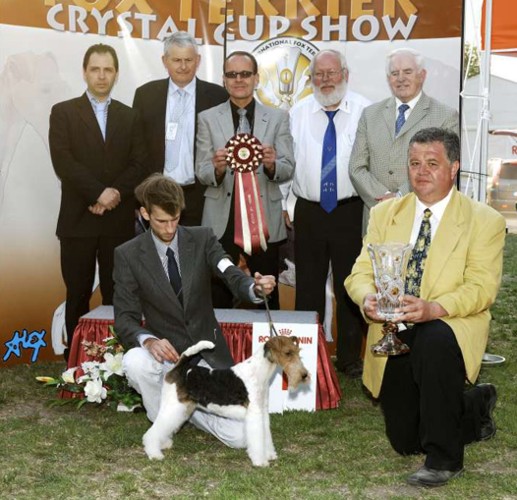
As the highest recognition, I consider the invitation to the 2011 international shows with Crufts qualification in Szilvásvárad at the International Chrystal Cup Fox Terrier Special Show where I served as ring secretary and interpreter in English, French and Italian languages for the 4 judges and specialists: Phillip Horspool (UK), Jari Spagna Rosario (I), Harry O’Donoghue (IRE) and Luc Detry (B).
Finally in 2012 the Hungarian Kennel Club started the Ring Secretary Course. Topics of the course included:
- Show regulations (Attila Márton)
- Ring secretary work in practice (Erdõsné Bocsák Éva)
- 2013 World Dog Show in Budapest: preparations and expectations (András Korózs)
- Kynology, anatomy, show judgement, movement (Attila Czeglédi)
The written exam proved to be quite difficult for the majority of participants (only about ten percent absolved it), but I wrote the test as 95% so was allowed for the oral exam, and taking my previous experiences into consideration, so I am now "officially" FCI MEOE Ring Secretary.
Mirror Method basic trainer courses
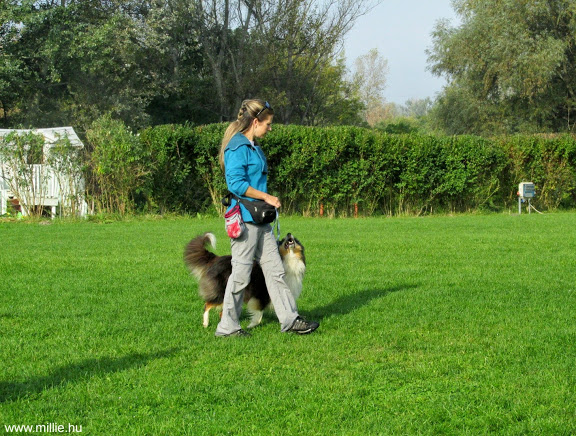
I have been training Millie with a new method: clicker and the Mirror Method. I enjoyed the dog kindergarten, basic and advanced courses where I discovered a new dimension of dog communication and I could combine it well with my previous experiences. Since I was curious about the theoretical background as well, in 2013, I participated at the TOP Mirror Method Basic Dog Trainer Programme 1 and 2 (first at part 2 during 2x2 weekends, then at the main course for 6 days and exam on the 7th day).
Topics of the course included:
-
Origins of the dog, pack animal or family member (Gábor Korom)
-
Canine-human relationship (Gábor Korom)
-
Raising a dog (Gábor Korom)
-
Veterinary presentation (Dr. Otília Biksi)
-
Dog training theory (Rudolf Hornig)
-
Clicker training (Rudolf Hornig)
-
Raising puppies (Belényi Beatrix)
-
Protection work (Gábor Korom)
-
Learning by the Ethologist's eyes (Dr. Topál József)
-
Dog sports and assistance dogs (Leczki Sarolta)
-
Neurology (Ferenc Suszter)
-
Obedience work (Ferenc Suszter)
-
Tracking (Ferenc Suszter)
-
Dog training for groups (Enikõ Szak Gyulainé)
-
Communications seminar (Ágnes Kresák, Enikõ Szak Gyulainé)
-
Dog communication and behaviour therapy (Dr. Ágnes Sátori, Mária Óbert, Ágnes Kresák)
To fully become a dog trainer, after the successful theroretical course, I'll need to practice at 3 basic courses, 1 advanced course and 1 month at dog kindergarten: I plan to perform it later since my weekends and spare time are now dedicated to my daughter.

OKJ Habilitation Dog Trainer course
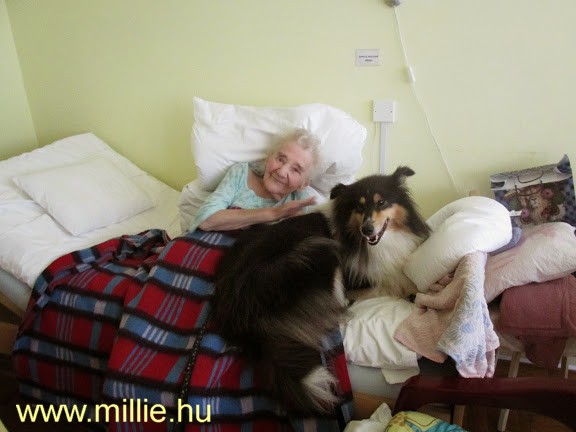
I planned to give an official framework to my therapy experiences so I participated at the OKJ Habilitation Dog Trainer course (OKJ is National List of Educations, this course is listed under number 528100110000000), organised by Focus Training Center.
Thanks to the modular structure, 3 modules were approved from the OKJ Dog Groomer course, so I could concentrate on the professional subjects. The course took almost 1.5 years, biweekly, our exams finished in December, 2014.
Topics of the OKJ Habilitation Dog Trainer course included:
-
-
1714-09 Safety at work, fire and environmental safety (Ingrid Lengyel, approved)
-
1722-06 Basics of enterpreneurship (Katalin Rácz, approved)
-
2835-09 Dog behaviour and animal welfare studies (György Kovács)
-
2836-09 Theory of the employment of service dogs (Ingrid Lengyel)
-
2837-09 Basic communications studies (Ingrid Lengyel)
-
2838-09 Service dog training and its legal regulation (Péter Vasteleki-Einbeck)
-
2839-09 Dog therapy in practice (Péter Vasteleki-Einbeck, Klára Kovács)
-
3116-09 Animal health studies (Dr. Attila Vainer, approved)
-
3117-09 Basics of dog keeping and feeding (Dr. Attila Vainer)
The exam consisted of three parts:
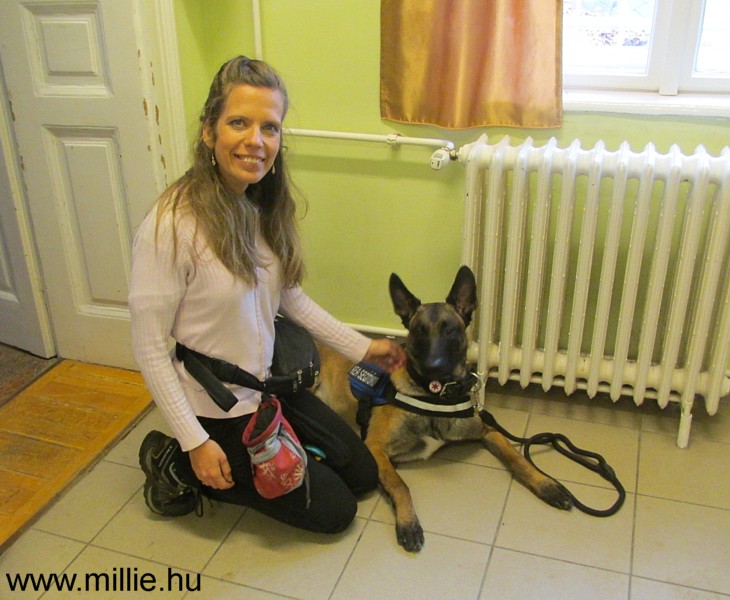
I am very proud that during my practical exam, a very shy girl who was afraid of dogs, by the end of the session, she handled the dog all by herself (Garde de la Vie Justice "Zen", belgian shepherd dog malinois, breeder: Leczki Sarolta, owner: Belényi Beatrix, KEA TKF-A434), even the members of the committee were applauding. I received 100% or around in several modules at the exams, so I finished best of group with 98% average performance.
I would like to take the opportunity here as well to say thank you to all who helped me.
 .
. .
. .
. .
.
 .
. .
. .
. .
. .
.
Further photo albums:
05.07.2014 OKJ practice REX (REX Dog Home Foundation)
19.07.2014 OKJ practice REX
23.09.2014 OKJ practice Home for Elderly People (Bischitz Johanna Integrated Humane Services Center)
27.09.2014 OKJ practice Young Ladies Home (EMMI Rákospalota Correction Institution and Special Childrens' Home)
11.10.2014 OKJ practice REX
25.10.2014 OKJ practice REX
22.11.2014 OKJ exaxm REX
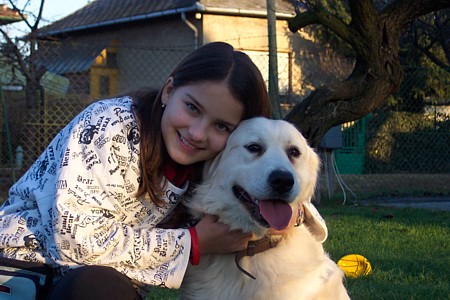 Reno, golden retriever |
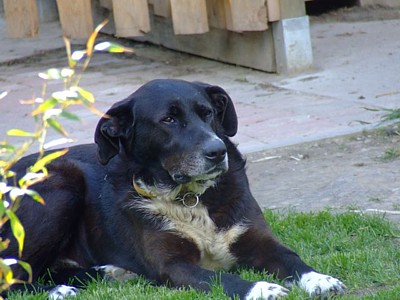
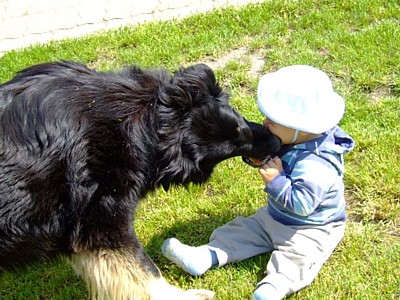
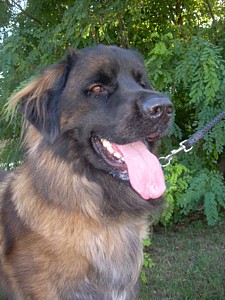
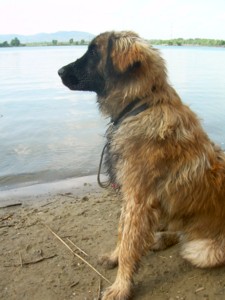 Othello Löwe Von Blumengarten "Astor", leonberger |
|
 HVCH Kassy Vom Matthiasberg "Carmen", leonberger |
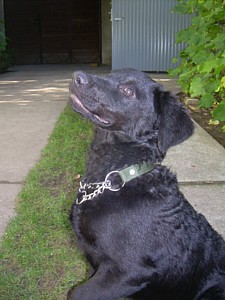
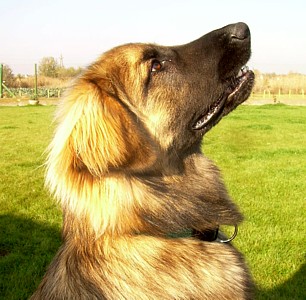 Árpádházi Bársonytalpú Leo Balu, leonberger |

"Dear Andi! We would like to thank you for your help in dog training and "owner training": without you, we would never have been able to train Arva (Orphan), the rescued dog with love and competence to listen to us and to come back to us even in an unknown area, and today he and Damil are fully reliable members of the family." - Hajnalka F., Diósd
"Hi
Andi! Brumi received Excellent, Carmen is Veteran Champion!
Thank you very much for your help in show handling training!" - Emõke
I., Budaörs
"Balu
would like to thank your for your help (and we too, of course). We hope
we can count on you in the future as well!
He does not jump on us anymore, "sit, down and stay" all go
well! Leash excercise is not 100% yet but it's only on us now.
Thank you very much again! Kind regards: Balu and his Owners" - Mariann
Cs., Pest county
"Arthur
the westie had such an independent personality: he would not listen to
anybody. We could only walk him on the leash. With your help, Artur is
now paying attention to what we say, and I can't describe what I felt
when for the very first time he was free while walking! Thank you so much
Andi." -
Aranka and Gabriella P., Budapest
"Andi, we owe you Dotti's MKSZ Hungaria Junior Champion title. Thank you very much!" Adrienn F., Sárbogárd
© Mador.hu